“When should I start applying for that internship?”
“Where do I start with my job search?”
“Do I need to be sending my resumes out now?”
There’s a point of recognition where the senior public relations major realizes that yes, barring any major gaffes, chances are good that they’re going to graduate and need to find a job. And then the panic sets in.
Senior year both flies by in a blink and seems to drag on forever at the same time. Benchmarking a few key activities may help you create your own plan for prepping for graduation.
A quick note: University of Oregon is on the quarter system – we start the last Monday of September and finish mid-June, so this calendar may vary based on your University.
Did you know that 247 billion emails are sent every day. This equates to one email every 0.00000035 seconds. Somedays it feels like half of those are delivered straight to my inbox. (Source)
An invaluable communication tool, email is probably the method I use most to interact with colleagues, clients, students and friends. However, I get around 300 or so emails a day. That, combined with a very full schedule means sometimes those emails go unanswered (or even unseen). There’s no way I have a corner on the lots-of-email-busy-schedule market, so I’m often on the other end — sending an email, trying to get a busy person to reply to my requests.
So how do you get busy people to respond to your emails? Some tips:
For the first two years of my life, my dad was an itinerant preacher who would travel all over the country, usually by car, with my mom and his new daughter in tow, preaching at Bible colleges and churches big and small. We crisscrossed North America during that time – in fact, by the time I was two, I’d been to more than half the states in the US.
That’s a lot of time spent in the car and my mom tells me that for hours upon hours every day, she’d read to me.
This sparked a love of reading that carried me through school. I remember reading Les Miserables when I was about 10; it was the first book that made me cry, or more accurately, sob uncontrollably through the last chapter. I remember reading with the third graders in the school library when I was just a first-grader and feeling special. I remember leaving the public library in any town we lived in with more books than I could carry. I’ve always loved to read.
Fast forward to 2021 and I rarely read for pleasure. I read a ton, but it’s for work, for classes or for research. About a year ago, I started working with Reflection Point, a nonprofit that works with companies and organizations of all shapes and sizes to build relationships through storysharing. The concept sounds like a book club when you first describe it — a group of people get together and read and discuss a story. But it’s definitely not a book club.
The storysharing focuses on encouraging the participants (guided by a facilitator) to use the story as a springboard for conversations… for giving space for people to talk about their lives, their childhoods, their history, their families, their biases and their perspectives in a new way that isn’t threatening. In fact, it creates stronger teams and more inclusive workplaces.
I’ve worked with lots of clients that do lots of interesting things and I always try to immerse myself in their work to really understand them (shall I tell you about the time I learned to knit because I worked with a client that made exotic wood knitting needles?). Reflection Point has been a different experience.
I now read a lot of short stories and poetry – at least one or two a week. Sometimes I’m reading them for social media content, but more and more, I’m reading them for myself. I read through the lens of how do I relate to this story? how might others? what kind of conversations could we have about this? And once a month, I join the Reflection Point internal team for a facilitated conversation about a new story that they’re testing.
Turns out, we all have a lot in common and our conversations are funny, serious, thought-provoking, vulnerable and refreshing. I look forward to it every month.
Even if you’re not having conversations about them, read more short stories! And think about how you relate (or don’t) to the characters. Do they give you a new perspective on a problem or an issue? Some of my recent favorites:
In Camille Acker’s “All the Things You’ll Never Do,” we meet Bess, a TSA agent w/ literal & figurative baggage, working to be seen & respected. Who don’t you “see” in your life? The story makes me think of the quote, “be kind because everyone is fighting a battle you know nothing about.”
This time it’s Naira Kuzmich’s “The Kingsley Drive Chorus” set in L.A.’s Little Armenia. It’s a powerful narrative about mothers & sons (and life & death). This one broke my heart over and over.
Ever had advice from a mentor that didn’t sit well or felt inauthentic to you? Chibundu Onuzo’s short story “Sunita” is about mentorship & marginalization.
Greg Jackson’s “The Hollow” is a new short story just published in November. So much about this story made me remember those (very) hard years in my 20s when I was trying to figure out who the heck I was and how do I build a life and a career?
I find myself saying, “I read this great short story!” and sharing those stories with my social media connections, my Reflection Point friends and saving them in a folder for another day when I might need that message.
I may not be able to curl up in a corner for hours on end devouring every book I can get my hands on, but I do feel more connected to the power of story and the impact a great story can have.
I’d love to hear your recommendations for stories you love.
To start this bizarro-world term, I had students in my Spring 2020 PR Campaigns class spend some time thinking about how to set themselves up for success. Like it or not, working from home is going to be our new normal… even when things get back to normal.
I shared a handful of resources & then asked each student to find another that they found helpful to add to the list.
First, I’ll share my list. I wanted to both find practical tips, but also help them see that this term is a great time to build some skills in working from home… and honestly, that’s it’s not a fad. Much of the work we do in PR and comms is either already done remotely or easily could be.
How to Work From Home as a Team (Minute Earth via YouTube): This is my favorite find for this module. The Minute Earth team video shares really practical tips for TEAM collaboration remotely. This was the number one concern my students had going into this term.
Now for my students’ finds (and their comments about why they’ve shared a particular article or resource). You could consider this a master list of tips and ideas, to be sure! Also: Forbes in killing it in either good advice or good SEO… probably a bit of both.
I’m sharing this article about how to make an at-home office space because I think it’s important to have a workspace that minimizes distractions and gives you a space to feel the most productive. – Suzie G.
I’m sharing this article about how to create an at-home working space that is separate from your living space and will allow you to be productive. – Hannah M.
This article stuck out to me because it addresses the overwhelming amount of distractions (social media, roommates, Netflix, etc). The author suggests that the most important tip for staying focused while working from home is to create a contract with yourself, which I think could be very beneficial. – Hannah C.
I enjoyed this article because I really liked what was said about mental and emotional health. This is obviously a time that is making everyone a little more on edge, so I think it’s important to practice self-care and do what’s best for yourself to stay happy and healthy. – Elise H.
I want to share this article because it mentions the importance of technology in a tough time. It is the most effective way to keep communication with the outside world. Since most physical stores(including telecoms) are closing now, we need to repeatedly check our internets and other devices to ensure they are working in order. – Andy P.
I’m sharing this article because it ties in similar strategies like the ones above, such as being able to claim your own space and set your boundaries with those you might be quarantined with. – Savannah K.
This NPR article gives you 8 really good and concise tips on how to work from home and I found it really helpful! – Cole K
This article is about how to work from home with a spouse, but a lot of the tips can work for family members, roommates or significant others who many of us may be quarantined with. We may usually be excited about the prospect of getting a day with them, but months on end can strain any relationships so setting up some rules may be really helpful. – Josie R.
This article offers five clear, simple ways to manage personal stress during this pandemic. I appreciate these suggestions because stress management is a key to success; I am more productive when I’m not stressed out, so finding ways to keep ourselves calm and collected will be helpful throughout this term. – Jodi A.
The article offers helpful tips for students to adapt to remote education, some of which I had not even thought about myself such as the advice for optimizing my internet. – Lorenzo C.
I’m sharing this link because it’s very authentic. A lot of people are writing about this topic and giving their opinions given society’s new way of life, but the employees referred to in this article have done it for years and offer good advice. – Regan H.
I found this article entitled 7 Tips For Working Remotely During Covid-19. I am going to share this because I am going to write these 7 steps in my planner notes to remind me that remote work is achievable and I can be successful during this time if I create a set schedule for myself. – Caitlin E.
Trying to work from home while balancing family priorities is a new challenge. I liked this article from Forbes sharing how to balance different relationships at home while still making time to get your work done. – Kelsey F.
I really liked this article because it is very applicable to this class and how we can be successful in our teams! It talks about staying connected to your co workers, having clear communication, outlining expectations etc. – Maddy F.
I think assessing one’s mental health is already necessary, but even more so with coronavirus. A little unrelated to resources for at-home productivity, but definitely essential for getting through your day and staying healthy in the long run. – Alexa M.
I liked this Cosmo article because it provided people’s actual experiences from their “home offices”, so you get real feedback about what works and what might be helpful to you too. – Gracyn E.
We’re in the thick of job & internship season. LinkedIn can be your best friend for researching contacts, companies and opportunities.
The most frequent question I get is “do you know anyone at XYZ organization?” With a little research via LinkedIn, you can answer this Q and ask instead, “I see you’re connected to this alumni, can you help connect us?”
Advanced search filters are your friend! Here’s how to use them:
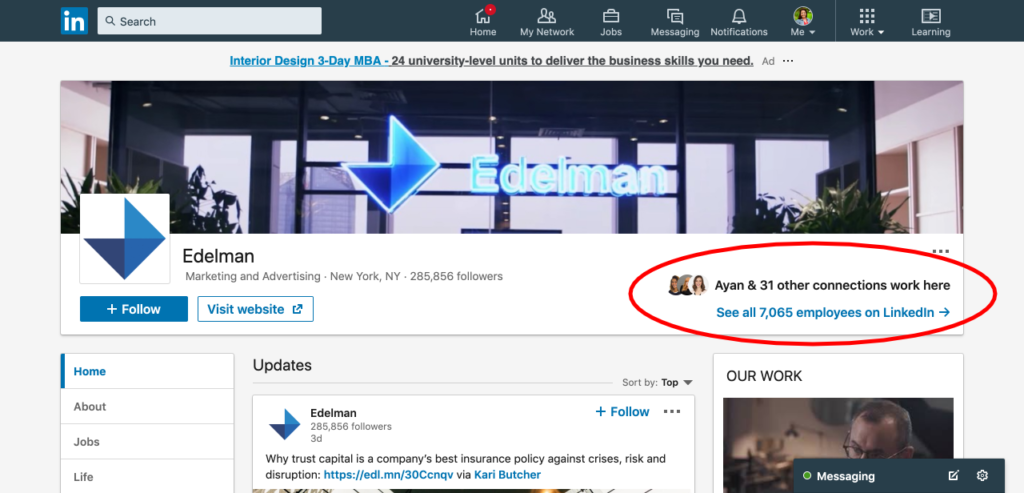
Enter the company name in the search bar at the top of the screen and find the company’s page on LinkedIn
Check out that right side info. It’ll tell you if you have a contact there (or in this case, 32 contacts).
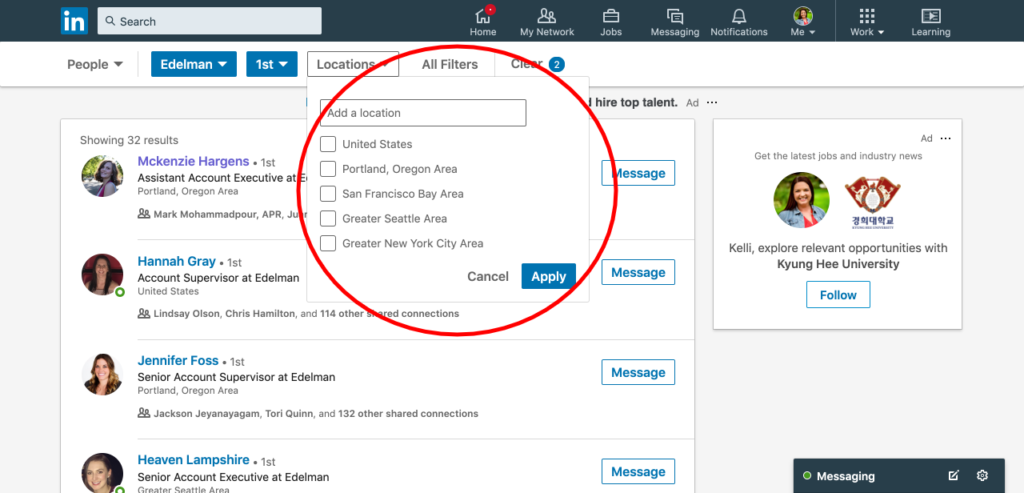
If you have contacts, you can click on that line to see who you know. You can narrow by location — in this case, I’m interested in who I know at Edelman in Seattle.
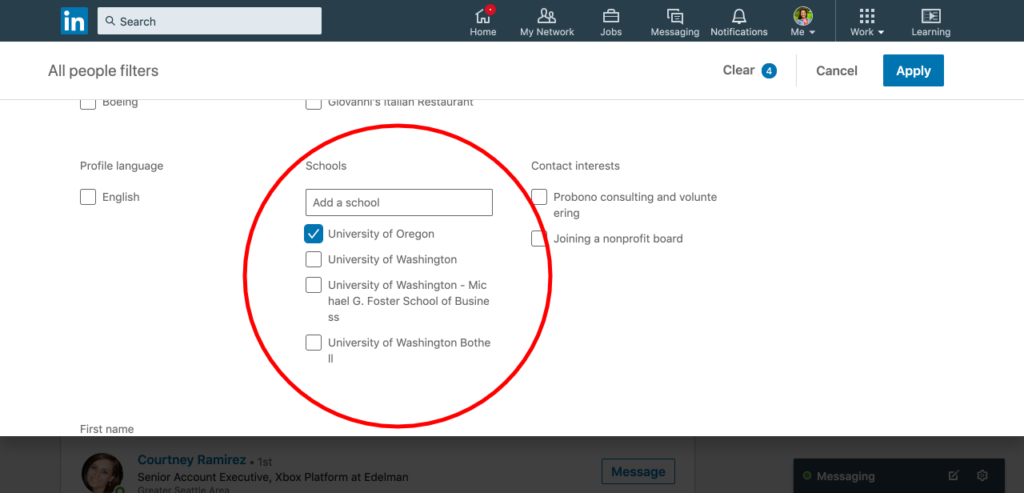
Then narrow to alumni. #OnceADuckAlwaysADuck
And voila! You’ll end up with a nicely refined list.
But what if you don’t have any contacts at the company? A common dilemma when you’re just starting to build your network.
In that case, click on the number of total employees and refine with the search filters.
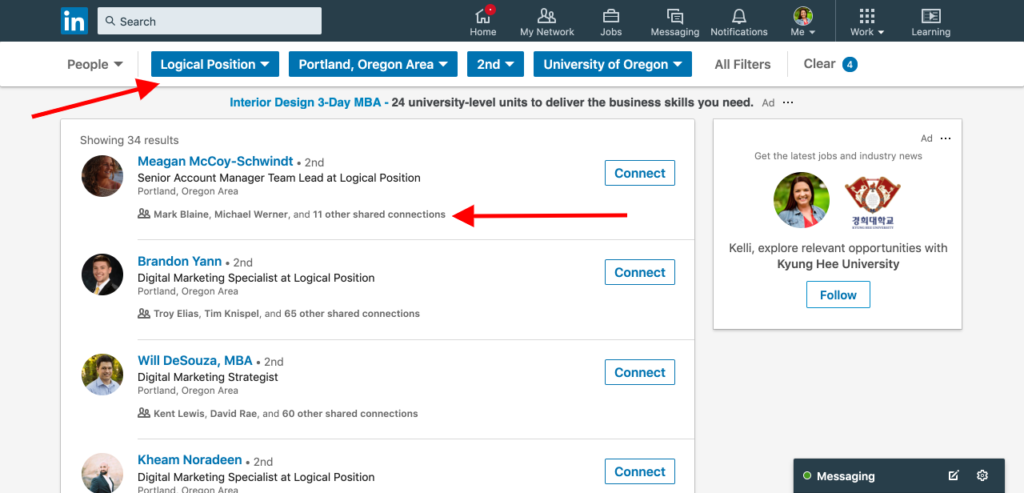
In this case, I’m looking for 2nd degree contacts, who are also alumni of the University of Oregon, and work at Logical Position in Portland. Take note of the search filters across the top.
This search gives me 34 people. Under each person there’s a small line that says how many shared connections we have. If I was interested in connecting with anyone on that list, I have two options:
First, ask a mutual connection to make an e-introduction or provide an email address. This can be helpful if there’s a specific opportunity you’re applying for. You can say, “Kelli, I see you’re connected to XYZ on LinkedIn. I’m applying for an internship there. Would you mind making an email intro so I can ask a few questions or get some tips for my application.”
Second, reach out myself! Click that connect button and send a note that says something like, “I’m a soon-to-be-grad of the School of Journalism and Communication at the University of Oregon and excited to launch my career in Portland. I’m building my network of fellow alums who work in public relations/marketing/advertising in the area.” This is a powerful way to build your network and connect with alumni.
More than 50 public relations Ducks spent two days in San Francisco meeting with agencies and PR teams. It was two days of soaking up all the info, walking all the miles and meeting so many alumni and friends.
So, what’s next? Take advantage of all the learning done and connections made:
OutCast Agency
Take a minute and capture your key takeaways. Review your notes, reflect on the experience, write a short blog post for your own blog or as a guest blog for a student group, a professor or your school. (Note: I’d be happy to host a blog here!)
Follow-up more directly with your priority contacts. Send a handwritten card or a thank you email that calls out your specific interest in their organization. Not sure what to say? Here’s some advice.
Set up Google Alerts for your priority agencies/companies and their clients. When a client gets a piece of coverage or some exciting news, you can follow up again with your contact and congratulate or ask about how the campaign worked.
Try out the specific advice that your connections offered. For example, several panels mentioned things like read relevant media every morning or practice your writing. Find a way to build that into your routine!
The SalesForce “Ohana” Floor
Our SOJC alumni and friends are so generous with their time and energy! Make the most of the visit with a few simple steps. Have others to add! Share with me.
I’m not going to lie, as an undergrad, the idea of doing investor relations would’ve given me the heebie jeebies. Math? numbers? all those regulations? Blech.
As a professional, I’ve learned that not only are numbers and math your friends, they can be a lot of fun. And regulations? Everyone’s got ‘em. Communicating complex info in a clear, persuasive way while navigating the rules and regulations along with company culture and politics is pretty much what we do.
Had I had some mentorship or just some instruction in financial communication, I might have taken a different path. Or I’d at least had some sense of all the options for a career in public relations.
So I was pretty excited when, this spring, the PR sequence at the SOJC launched IR Futures, an investor relations-focused student club. We have a couple of stellar faculty who have expertise in investor relations and financial communications and this is a growing area of focus for the PR sequence.
Classes are wrapping up at the University of Oregon and we’re all more than ready. I get the need to hibernate over the break. I intend to do some of that myself. But if you feel like getting a job start on the intern or job search, winter break can be a great time to focus. And if I know our PR students, they’re not likely to “hibernate” for long.
Some suggestions to make the most of your winter break:
Update your resume (and LinkedIn). Adding new positions, editing based on instructor or professional feedback, playing with the layout and design… Your resume is in a constant state of change at this stage in your pre-professional career. Make sure it’s up-to-date. While you’re at it, update your LinkedIn profile and add some new connections.
Work on your e-portfolio. An online home for your writing samples and resume is a must. If you already have an e-portfolio, take some time to update the materials. If you don’t have one, this is a great time to start. Finding a platform (I like WordPress) and uploading your favorite writing samples is a good start.
Research. Research companies you want to work for, who their clients are, what kind of jobs are available while you have time to follow the Internet rabbit trails (and have fun doing it!). You can find some tips here to get started.
Do some informational interviews. If you’ve done some research, reach out to people working in PR and set up a time to chat over coffee. Info interviews are a great way to network and get to know the industry. An oldie, but a goodie… this post gives some great advice for informational interviews. It doesn’t matter if you don’t want to work in your hometown, you can always get out and meet some people. PR is a small industry and you never know where a chat over coffee will lead.
Editor’s Note: I don’t often post internship opportunities directly to my blog, but this one seems like a fantastic opportunity. My friend, Ed Madison and one of our students, Maya Lazaro are looking for some help with a political journalism project that focuses on K-12.
Engage 2012 is journalism challenge that asks K-12 students from schools throughout the United States to create 2-minute non-fiction multimedia stories from their communities about one of six topics relating to the presidential election. These topics include:
Voter Turnout
Jobs & the Economy
Education Reform
Health Care
Energy & Environment
Immigration
We are currently in the process of securing a panel of well-known journalists and professors from journalism schools across the country to judge the entries. Winners will potentially be announced on ABCnews.com and CBS This Morning.
We are looking for public relations students from the University of Oregon to help us draft and implement a communication plan to publicize the challenge. The plan would incorporate traditional and non-traditional advertising and public relations strategies. Applicants must be self-directed and dependable, in addition to possessing strong writing skills.
This is a volunteer position and will last until January 31, 2012. It will require between 10 and 15 hours of work per week, although that will vary depending on the month. Most of the work will be done from home. Volunteers are also expected to attend project meetings from time to time.
You will not be getting paid to work on Engage 2012. However, you will gain experience in copywriting, public relations, marketing, and project management for a semi-high-profile journalism project.
You’ll also be empowering elementary, middle school, and high school students to share stories from their communities and become politically engaged on both a local and national level.
If you are interested, please send your resume or a brief description of your previous public relations experience to Maya Lazaro at mlazaro@uoregon.edu by Friday, August 24 with the subject header “Engage 2012 Volunteer.” Direct questions about the project to mlazaro@uoregon.edu.
My favorite and the one I might not have thought of off the top of my head:
2. Look for jobs in the want ads in the foreign language press and on Websites for people [from whatever country you’re originally from] now living in the U.S. If an organization is looking for a bilingual speaker, that’s where they’ll advertise.