Category: Networking

  • A Year-Long Plan for Senior PR Undergrads

    A Year-Long Plan for Senior PR Undergrads

    [Updated October 2025]

     “When should I start applying for that internship?”

    “Where do I start with my job search?”

    “Do I need to be sending my resumes out now?”

    There’s a point of recognition where the senior public relations major realizes that yes, barring any major gaffes, chances are good that they’re going to graduate and need to find a job. And then the panic sets in.

    Senior year both flies by in a blink and seems to drag on forever at the same time.  Benchmarking a few key activities may help you create your own plan for prepping for graduation.

    A quick note: University of Oregon is on the quarter system – we start the last Monday of September and finish mid-June, so this calendar may vary based on your University.

    (more…)

  • Getting Busy People to Answer Your Emails

    Getting Busy People to Answer Your Emails

    Did you know that 247 billion emails are sent every day. This equates to one email every 0.00000035 seconds. Somedays it feels like half of those are delivered straight to my inbox. (Source)

    An invaluable communication tool, email is probably the method I use most to interact with colleagues, clients, students and friends. However, I get around 300 or so emails a day. That, combined with a very full schedule means sometimes those emails go unanswered (or even unseen). There’s no way I have a corner on the lots-of-email-busy-schedule market, so I’m often on the other end — sending an email, trying to get a busy person to reply to my requests.

    So how do you get busy people to respond to your emails? Some tips:

    (more…)

  • Guest Post: Networking in the Time of Isolation

    Guest Post: Networking in the Time of Isolation

    Kelli’s Note: Kayla has been a rock star with the informational interviews, not only doing a lot of them, but approaching each very strategically. I asked her to share her advice here.


    By Kayla Thomet

    Everyone says that the most important thing you can do during this strange and difficult time is network, network, network. That’s all fine and good, but what does it actually mean? How are we supposed to network in a time when we can’t even leave our homes?

    For the past month, I’ve been on a complete networking journey – researching tips and tricks, delving into different platforms, and, of course, practicing. I’ve learned there’s a whole network of strangers out there on my team; all I had to do was ask.

    Cold-calling is a stressful and nerve-wracking process. I always worried: “am I bothering them?” But what I learned is that people are not bothered at all; in fact, they find joy in helping you. Many successful professionals got their start from networking, from the kindness of a stranger. From over 35 informational interviews, I’ve learned a few best practices along the way.

    LinkedIn can be your friend or your foe.

    LinkedIn can be one of the most useful tools in searching for a job; however, it can also be intimidating to the first-time user. Take the time to set up your profile and perfect it – make sure to include featured work, a professional headshot, a goal-driven “about” statement, and a detailed description of all work experience.

    Use Youtube and other online resources to learn how to use the filter features to refine your search. You must have a quality profile to attract connections and impress potential future employers.

    Utilize your alumni network.

    There are alumni networks for regions and cities all across the country full of professionals willing to connect and help. Reach out to alumni leaders in the regions you want to move to and ask if they know of anyone in the industry you want to work for.

    Additionally, you can use filters on LinkedIn to sort by school; the University of Oregon, in particular, has amazing alum willing to chat with any fellow Duck.

    Search for individuals who work in your field or for companies that you want to work for and connect with them.

    Identify companies and specific industries you want to work for. Reach out to people working for your dream company; even though you may not start out there, you can learn different paths to get in and put your name on the minds of the people who work there.

    While searching, make sure to connect with people in roles you are interested in – you may find that the reality of a position is different than you thought. 

    Be sure to customize your invitations to connect.

    On LinkedIn, you have the option to customize a message with your invitation to connect. Always customize a message to whoever you are trying to speak to – it shows effort and sets you apart from random requests. Explain who you are, what you hope to learn, and express your desire to learn about the company and its culture.

    Follow-up, always.

    Be sure to send a follow-up email or message the following day thanking them for speaking with you. I’ve found that it’s helpful to include at least one piece of advice which they gave you that resonated with you. It shows you listened and genuinely took their advice to heart.

    Questions to ask once you get the informational interview:(Not a question) but make sure you start with gratitude and humility – you’re here to learn.

    1. Can you share with me a bit about your journey?
    2. How did you figure out what you’re passionate about?
    3. What is one piece of advice you wish you had known at my age?
    4. Do you have any newsletters or blogs you recommend I read?
    5. The golden question: who else do you recommend I talk to?

    My name is Kayla Thomet and I’m a graduating senior from the SOJC at the University of Oregon with a major in PR and a minor in business. My greatest passions in life are fine wine, sustainability, and, above all, people. In the future, I hope I can find a career that will allow me to combine my passions to better the world.

    Connect with me on LinkedIn

  • I Went on an Agency Tour!  Now What?

    I Went on an Agency Tour! Now What?

    More than 50 public relations Ducks spent two days in San Francisco meeting with agencies and PR teams. It was two days of soaking up all the info, walking all the miles and meeting so many alumni and friends. 

    Our PR Ducks are lucky to have the opportunity to participate in several experiential learning opportunities — Golden Gate Ducks (San Francisco), Windy City Ducks (Chicago) and quarterly professional development tours with our Public Relations Student Society of America chapter

    So, what’s next? Take advantage of all the learning done and connections made: 

    OutCast Agency
    • Take a minute and capture your key takeaways. Review your notes, reflect on the experience, write a short blog post for your own blog or as a guest blog for a student group, a professor or your school. (Note: I’d be happy to host a blog here!) 
    • Connect to the people you met on LinkedIn. When you ask to connect, leave a short note that says when you met and thank them for their time/expertise/inspiration. The Muse has some advice about connecting with people.
    • Follow-up more directly with your priority contacts. Send a handwritten card or a thank you email that calls out your specific interest in their organization. Not sure what to say? Here’s some advice. 
    • Set up Google Alerts for your priority agencies/companies and their clients. When a client gets a piece of coverage or some exciting news, you can follow up again with your contact and congratulate or ask about how the campaign worked. 
    • Try out the specific advice that your connections offered. For example, several panels mentioned things like read relevant media every morning or practice your writing. Find a way to build that into your routine! 
    The SalesForce “Ohana” Floor

    Our SOJC alumni and friends are so generous with their time and energy! Make the most of the visit with a few simple steps. Have others to add! Share with me.

  • Asking for a LinkedIn Introduction

    Asking for a LinkedIn Introduction


    LinkedIn is such a valuable tool for any job seeker, but for undergrads looking for informational interviews, networking connections or to research a potential company or interviewer, it really can’t be beat.

    But using it well (and not annoying your connections) takes a little know how and some LinkedIn etiquette. I think no where is this more true that in asking for introductions.

    LinkedIn allows you to reach out to people directly to make a connection (I always recommend adding a personal message about why you want to connect). However, using the “Get Introduced” feature, can help facilitate a connection and give you an edge.

    So how does it work?

    Start by finding someone you want to make a connection with. You can do this is many ways, but my two favorite (and most basic) are to a) search the connections of one of your contacts. If you’re connected to me, you have access to my 1500+ connections. You can sort by city (say you want to move to Los Angeles) or by company or a few other filters or b) search LinkedIn directly by name or company.

    Look for second degree connections. That means just one person exists between you and them.

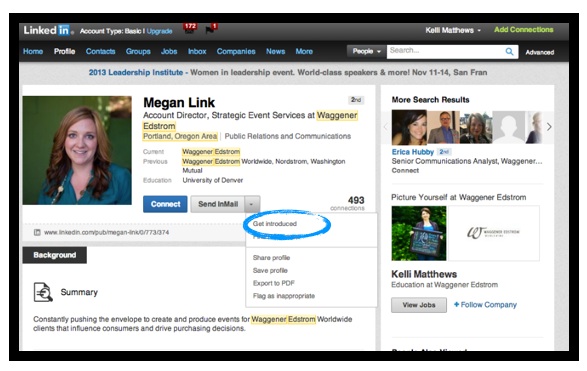
    Recently, I did a company search for Waggener Edstrom Worldwide. A lot of our grads work at WaggEd and it’s the largest PR firm in the northwest. In doing that search, I found an account director to whom I had a second degree connection. I found her profile interesting because we have so many students with an interest in event planning — and that’s what she does for WaggEd clients. Neat.

    So say I want to get connected to Megan. Here are the steps to follow:

    1. Click on the arrow next to “Send InMail” to get the drop down options. The first says “Get introduced.” Choose that option.

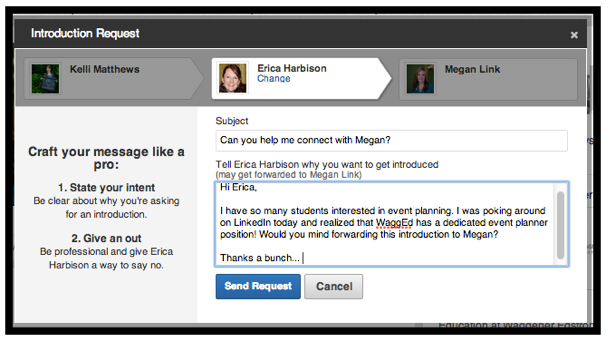
    linkedin-intro-screenshot 2. The next screen will show you all the people who you and the desired contact have in common. Turns out Megan and I have several mutual connections. Choose the one that you think would be most willing to “put in a good word” for you. I chose my friend, Erica, also an account director at WaggEd. She and I did our undergrad work together in the SOJC and I know she’d be willing to facilitate this connection for me.

    I started with a note to Erica about why I wanted to connect with Megan.

    Screen Shot 2013-05-17 at 9.09.44 AM


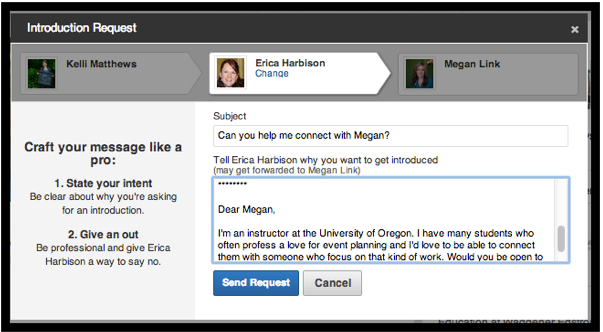
    3. The final part is the most important. To make it easy breezy for Erica to forward my connection request with her own note, I finish the request with a note directly to Megan. Consider a mini cover letter. Why do you want to be introduced?

    Screen Shot 2013-05-17 at 9.15.24 AM


    That’s it! Take a read through, do a final edit and hit “Send Request.”

    Erica will get a notice in her inbox that I’ve requested an introduction with the option to forward or decline.

    Have you used this feature of LinkedIn before? Any tips beyond what I’ve offered here?


    Related Posts with Thumbnails